

0+
Trusted Local Experts
Concrete Slabs in Kent
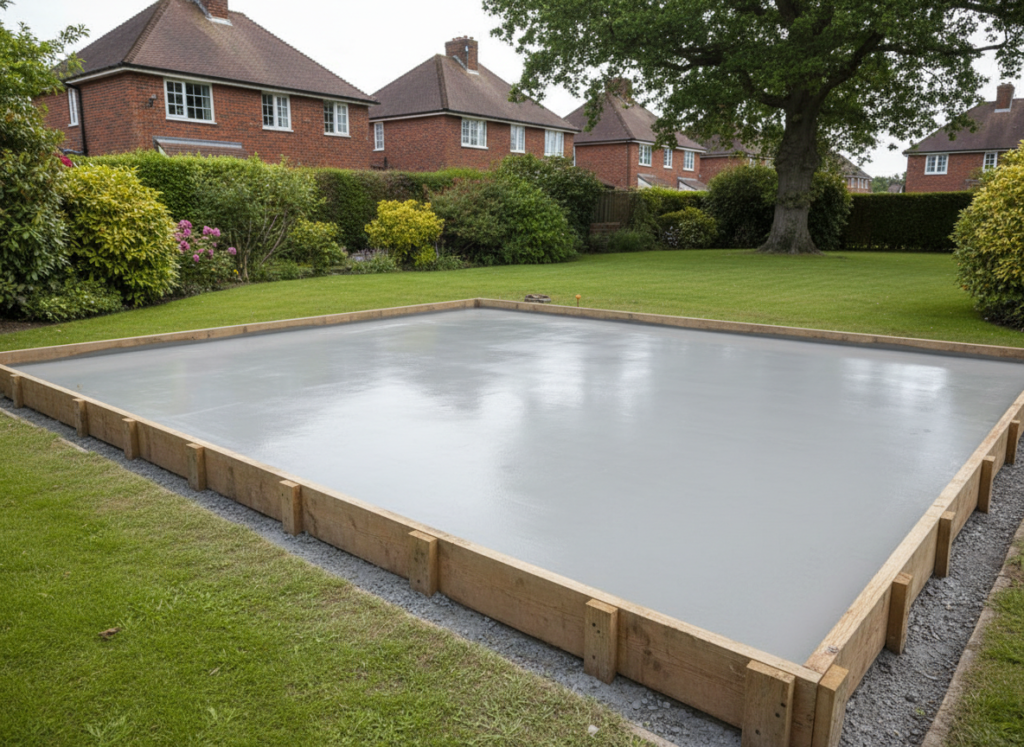
A concrete slab is a single continuous pour laid over a compacted sub-base to carry a building, a vehicle or a load. Kent Readymix provides ready-mix concrete for slabs across Kent and Medway, with the grade and volume settled before delivery day.
- 0%
Fixed Price Model
1-2-1
Personal Service
Local, reliable, fully insured
What a ready-mix slab pour involves
A slab pour cannot be paused: the concrete arrives ready-mixed and is placed in one working session, so the ground beneath it must be right before the load arrives. Ready-mix’s advantage is one strength from one batch across the whole slab, rather than the varying strength and cold joints of a barrow-mixed pour.
Which concrete mix suits a slab
Concrete is ordered by designation, not by description. Under BS 8500, a shed base, a greenhouse base or a garden building slab is commonly poured in GEN3. A slab that will carry a vehicle usually steps up to PAV1, which is air-entrained so that it resists freeze-thaw damage and de-icing salt. A slab carrying a structure or a designed load takes a reinforced concrete class such as RC25/30 or higher.
Those are the mixes that typically suit those jobs. They are not a specification. Anything structural is the engineer’s call, and where drawings exist the designation printed on the drawings is what gets ordered.
Working out how much concrete a slab needs
Slab volume is length times width times depth, all in metres, which gives cubic metres. A slab 5 metres by 4 metres at 150mm deep is 5 x 4 x 0.15, so 3 cubic metres.
Two things move that figure once you are on site. Dug levels are never exactly as drawn, so the sub-base runs thin in places and the concrete makes up the difference. And a slab poured against an existing structure often needs a thickened edge. It is normal to allow a margin over the calculated figure, and your approved supplier will say what allowance they would order on for the job you describe.
Getting the base right before the concrete arrives
A ground-bearing slab is only as good as what sits under it. In order from the bottom: a compacted sub-base, usually MOT Type 1; a sand blinding so the sub-base cannot puncture what goes over it; a damp-proof membrane, lapped, taped and carried up to meet the damp-proof course; insulation where the slab is inside a heated building; then reinforcement, either mesh on spacers or fibres batched into the mix.
Two conditions stop a pour on the day. Standing water in the excavation dilutes the face of the concrete, and frozen ground robs it of early strength. Both need resolving before the load is batched, not when the lorry is already on the drive.
Access, discharge and how far the chute reaches
A standard mixer discharges down a chute, and that chute has a limited reach. Where the slab sits beyond it, the concrete has to be barrowed, pumped, or brought in on a smaller vehicle.
That decision belongs to the site rather than to the slab. A rear garden reached only through a house, a lane too narrow for a full-size mixer, a soft verge, a low bridge or a weight restriction all change what can be sent. Kent Readymix takes the access detail with the enquiry so that the right vehicle arrives first time, and where a chute will not reach we look at mini-mix delivery or a concrete pump instead.
What your approved supplier confirms
Kent Readymix works with approved concrete suppliers across Kent and Medway. Most of them work on a pay-for-what-you-use basis, and many can deliver next day. Your quotation, delivery and payment are agreed directly with the approved supplier appointed to your pour.
The supplier confirms the delivery window rather than the site guessing at it. Concrete has a genuine working life from batching to discharge, and the window depends on the load in front of yours and the distance from the plant, so it is settled by the people holding both facts.
Booking a slab pour in Kent and Medway
Tell us the slab size, the depth, what will sit on it and how a lorry would reach it. That is enough for an approved supplier to price the load and confirm the mix. Where you have an engineer’s drawing, the designation on it is what we quote against.
We will also say plainly when a pour is better served by a pump or a volumetric mixer than by a standard delivery, because the wrong vehicle on a tight site costs more than the right one.
Work Out How Much You need
Concrete Volume Calculator
The concrete calculator needs JavaScript. Contact us and we will work out the volume with you.
What We Do
Common Concrete Slabs Jobs We Handle
Shed and greenhouse bases
Garage floor slabs
Garden room and summer house bases
Patio and terrace slabs
Workshop and outbuilding floors
Extension and utility room bases
Why book with us
Why Choose Us for Concrete Slabs
One Batch, One Consistent Strength
Ready-mix concrete arrives already mixed to a single specification, so the whole pour goes in at one strength from one batch. Concrete mixed on site in a barrow mixer varies across the area and leaves a cold joint wherever one batch met the next.
You Describe the Pour Once
Set out what you are pouring, roughly how much, where a vehicle can stand and when you want it. That description goes to the approved supplier appointed to the job, rather than being repeated down a list of numbers.
The Mix Specified Before It Is Ordered
Concrete is ordered by designation under BS 8500, not by description. A shed base, a driveway and a structural slab take different mixes, and the designation is settled with your approved supplier in advance rather than argued about on the day.
Access Settled Before Delivery Day
How the concrete reaches the work is the question worth answering first: what can legally stand in the street, how far the chute reaches, and whether a pump or a smaller vehicle is the honest answer. Describe the access and it is planned rather than discovered.
Volume Planned Rather Than Guessed
Where a volume is genuinely uncertain until the ground is open, a volumetric mixer makes the concrete on site and most of our approved suppliers work on a pay-for-what-you-use basis. Where the figure is known, a standard load is usually the simpler answer.
Every Pour Type Across Kent and Medway
Slabs and floors, footings and foundations, driveways, columns and walls, volumetric and mini-mix loads, and pumping where a vehicle cannot reach the work. Domestic and commercial, across Kent and the Medway towns.
We’re Here To Help
Your Common Concrete Slabs Questions Answered
There is no fixed minimum, but very small slab pours are often better served by mini-mix delivery than a full-size lorry. Kent Readymix takes the slab dimensions with the enquiry and an approved supplier will confirm the smallest load they can send, or suggest mini-mix where a full lorry would be poor value for a small area.
There is no fixed notice period, because it depends on how quickly an approved supplier can schedule the right vehicle for your access and date. Many of our approved suppliers can work to short notice, but the safest approach is to get in touch with Kent Readymix once the excavation and sub-base are booked in, rather than on the morning you want concrete.
Any concrete ordered beyond what the slab actually takes is used on site wherever it can be, such as topping up an edge or a nearby post hole, rather than wasted. If a genuine surplus remains with nowhere useful to go, it returns with the vehicle rather than being tipped on site. Tell Kent Readymix about any small extra job on site that could usefully take the excess, and your approved supplier will factor it into the order.
Yes, the route from where the lorry or mixer stands to the slab needs to be clear of cars, bins, planters and anything else that would block the chute or a barrow run. Kent Readymix asks about access at enquiry stage, and your approved supplier will tell you exactly what needs to be moved before their vehicle arrives.
Light rain does not usually stop a slab pour, but heavy or persistent rain can wash cement paste from the surface and weaken the finish. Your approved supplier will advise on the day whether to go ahead, cover the area, or reschedule, and it is worth having a tarpaulin ready to protect a freshly finished slab regardless of the forecast.
How firm a slab needs to be before it can be walked on depends on the mix used, the weather at the time, and the thickness poured, so there is no single figure that applies to every slab. Foot traffic can normally go on sooner than anything heavier, such as parking a vehicle. Your approved supplier can advise on the specific mix ordered and how it develops strength.
Local coverage, county-wide reach
Areas We Cover Across Kent
- Ashford
- Broadstairs
- Canterbury
- Chatham
- Dartford
- Deal
- Dover
- Faversham
- Folkestone
- Folkestone and Hythe
- Gillingham
- Gravesend
- Gravesham
- Herne Bay
- Hythe
- Maidstone
- Margate
- Medway
- Northfleet
- Paddock Wood
- Ramsgate
- Rochester
- Sevenoaks
- Sheerness
- Sittingbourne
- Snodland
- Swale
- Swanley
- Swanscombe
- Thanet
- Tonbridge
- Tonbridge and Malling
- Tunbridge Wells
- West Malling
- Westerham
- Whitstable
- Ashford
- Broadstairs
- Canterbury
- Chatham
- Dartford
- Deal
- Dover
- Faversham
- Folkestone
- Folkestone and Hythe
- Gillingham
- Gravesend
- Gravesham
- Herne Bay
- Hythe
- Maidstone
- Margate
- Medway
- Northfleet
- Paddock Wood
- Ramsgate
- Rochester
- Sevenoaks
- Sheerness
- Sittingbourne
- Snodland
- Swale
- Swanley
- Swanscombe
- Thanet
- Tonbridge
- Tonbridge and Malling
- Tunbridge Wells
- West Malling
- Westerham
- Whitstable