

0+
Trusted Local Experts
Footings and Foundations in Kent
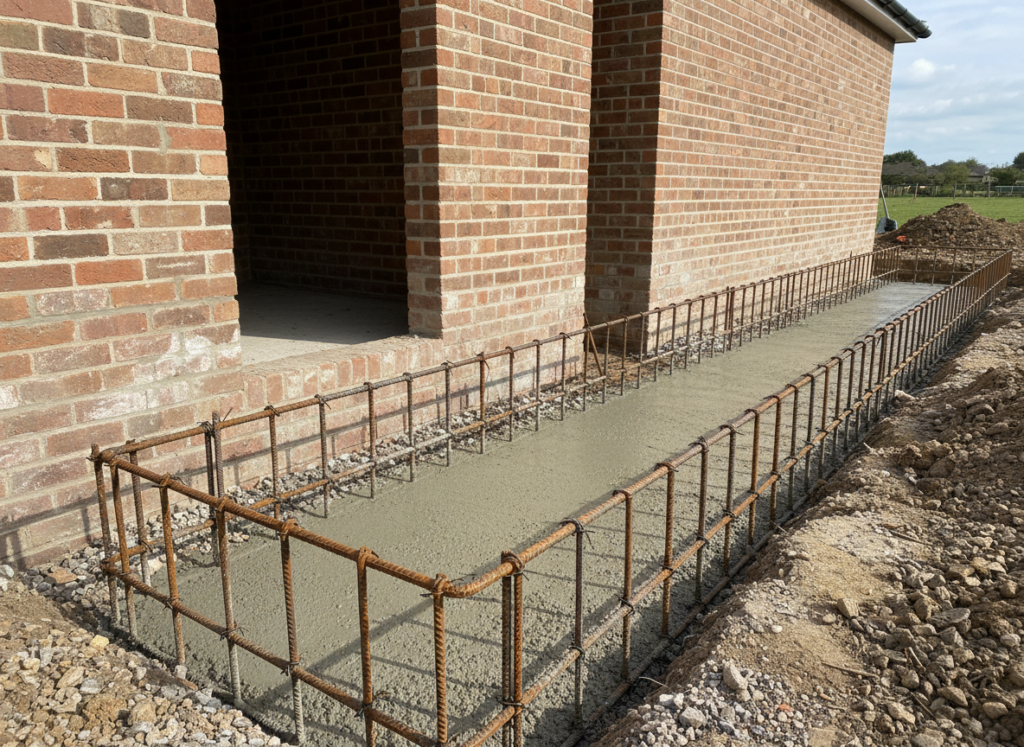
Foundation concrete is poured into an excavated trench once building control has inspected and passed it. Kent Readymix supplies ready-mix concrete for footings and foundations across Kent and Medway, matched to the depth, ground and designation on your drawings.
- 0%
Fixed Price Model
1-2-1
Personal Service
Local, reliable, fully insured
Trench fill or strip footing
A strip footing puts a shallow band of concrete in the trench and builds blockwork up to damp-proof course level; trench fill brings concrete almost to the top and removes most of that blockwork. It uses more concrete but far less labour and time, and gets the site out of an open trench sooner, so it usually suits deep foundations better than shallow ones. Decide before ordering, because the two need very different volumes.
The building control inspection comes first
Under the Building Regulations, foundation excavations are inspected before they are covered up. That is the point of the exercise: once concrete is in, nobody can see what it went onto.
Give notice to building control, have the trench inspected, and book the concrete around the result rather than ahead of it. An inspector can require the trench to go deeper, and a load batched for the original depth is then the wrong load. This is the single most common reason a foundation delivery has to be moved.
What sets the depth
Foundation depth is set by the ground, not by the concrete. Approved Document A of the Building Regulations covers the ground conditions that matter, and building control confirms the depth for your particular site.
Two factors drive most of it. Frost affects the upper layer of the ground, so a footing has to sit below the zone it reaches. And shrinkable clay swells and contracts with moisture, which is why foundations near mature trees usually go deeper than those on open ground. Where a site investigation exists, its findings govern. Where none exists, building control’s judgement on the open trench is what you work to.
Sulfates and the mix designation
BS 8500 has a family of designated foundation concretes: GEN1 for mass concrete fill in non-aggressive ground, and the FND range, starting at FND2, where the ground carries sulfates that would attack an ordinary mix.
Which one you need is decided by a chemical assessment of the ground, not by guesswork, and the result appears as a design sulfate class. If a ground investigation report exists, the class is in it. If it does not, your approved supplier will ask what is known about the site before batching, because supplying a standard mix into aggressive ground is a failure that shows up years later.
Working out how much concrete a footing needs
Trench volume is length times width times depth, in metres. A trench 20 metres long, 600mm wide and 900mm deep is 20 x 0.6 x 0.9, so 10.8 cubic metres.
Trenches are the pour type where the calculated figure and the real figure diverge most. A machine never digs a perfectly parallel trench, soft spots get dug out and made up in concrete, and a trench that has stood open through rain takes more than a fresh one. Allow a margin, and describe the trench honestly to your approved supplier rather than quoting the drawing at them.
Getting a mixer to a trench
Foundations are poured early in a build, which is usually the point at which a site has the least finished ground to drive on. A full-size mixer is heavy, and it will sink into ground that took a digger without complaint.
The practical questions are always the same: can a loaded lorry get within chute reach of the trench, is the ground firm enough to carry it, and can it turn or reverse out again. Where the answer is no, the pour goes in by pump or by a smaller vehicle making more trips. Kent Readymix asks about ground and access at enquiry stage so that an approved supplier sends something that can actually reach the work.
Placing concrete into a trench
Pump standing water out before the concrete goes in. Concrete discharged into water loses cement from the mix and sets weak exactly where it is carrying most.
Trench fill is normally ordered at a higher consistence class so that it flows along the trench and levels itself rather than needing to be dragged. Say what you are pouring into when you order, because the same strength of concrete can be supplied stiff or flowing and the wrong one turns an easy pour into a hard day. Your quotation, delivery and payment are agreed directly with the approved supplier appointed to your pour.
Getting a foundation pour under way
Send the trench dimensions, the depth building control has agreed, whether you are pouring strip or trench fill, and how a loaded lorry would reach the excavation. Where you hold a ground investigation report, the sulfate class in it decides the designation.
Many of our approved suppliers can deliver next day, and for commercial customers on an agreed contract, delivery within hours is sometimes possible depending on location and availability.
Work Out How Much You need
Concrete Volume Calculator
The concrete calculator needs JavaScript. Contact us and we will work out the volume with you.
What We Do
Common Footings and Foundations Jobs We Handle
Extension footings
Garden and boundary wall footings
Outbuilding and garage foundations
Retaining wall footings
Conservatory and porch footings
Why book with us
Why Choose Us for Footings and Foundations
One Batch, One Consistent Strength
Ready-mix concrete arrives already mixed to a single specification, so the whole pour goes in at one strength from one batch. Concrete mixed on site in a barrow mixer varies across the area and leaves a cold joint wherever one batch met the next.
You Describe the Pour Once
Set out what you are pouring, roughly how much, where a vehicle can stand and when you want it. That description goes to the approved supplier appointed to the job, rather than being repeated down a list of numbers.
The Mix Specified Before It Is Ordered
Concrete is ordered by designation under BS 8500, not by description. A shed base, a driveway and a structural slab take different mixes, and the designation is settled with your approved supplier in advance rather than argued about on the day.
Access Settled Before Delivery Day
How the concrete reaches the work is the question worth answering first: what can legally stand in the street, how far the chute reaches, and whether a pump or a smaller vehicle is the honest answer. Describe the access and it is planned rather than discovered.
Volume Planned Rather Than Guessed
Where a volume is genuinely uncertain until the ground is open, a volumetric mixer makes the concrete on site and most of our approved suppliers work on a pay-for-what-you-use basis. Where the figure is known, a standard load is usually the simpler answer.
Every Pour Type Across Kent and Medway
Slabs and floors, footings and foundations, driveways, columns and walls, volumetric and mini-mix loads, and pumping where a vehicle cannot reach the work. Domestic and commercial, across Kent and the Medway towns.
We’re Here To Help
Your Common Footings and Foundations Questions Answered
There is no set minimum, but a very small footing, such as a single post base, may be better suited to mini-mix delivery than a full lorry load. Kent Readymix passes the trench dimensions to an approved supplier, who will confirm whether a standard load, a part load or mini-mix is the right fit for the quantity involved.
Yes, where a trench sits beyond a chute’s reach or the ground will not carry a loaded lorry, a pump or a smaller vehicle is used instead. This is common on foundations poured early in a build, when the site has the least finished ground to drive on. Tell us about ground conditions and access and your approved supplier will confirm the right method.
The volume ordered can be adjusted before the concrete is batched, since trenches rarely come out exactly as drawn. This is normal on foundation work, where soft spots get dug out and made up in concrete and a trench that has stood open through rain takes more than a fresh one. Describe the trench honestly to your approved supplier rather than quoting the drawing.
Yes, the excavation should be inspected and passed by building control before the concrete is booked, because once it is poured nobody can check what it went onto. An inspector can require a trench to go deeper, and a load batched for the original depth becomes the wrong load, so booking around the inspection result avoids a wasted delivery.
Not entirely: a quote reflects the volume, mix and access described at enquiry, so it can change if the trench comes out a different size or the ground needs a different designation once opened up. Your quotation, delivery and payment are agreed directly with the approved supplier appointed to your pour, and they will confirm any change before the concrete is batched.
A general-purpose mix such as GEN1 typically suits mass concrete fill in ordinary ground with no aggressive sulfates present. That is a starting point rather than a specification, and where a ground investigation report exists, or the ground is known to carry sulfates, a different designation from the FND range is usually needed instead. Your approved supplier will ask about the ground before batching, and anything structural should still go to an engineer.
Local coverage, county-wide reach
Areas We Cover Across Kent
- Ashford
- Broadstairs
- Canterbury
- Chatham
- Dartford
- Deal
- Dover
- Faversham
- Folkestone
- Folkestone and Hythe
- Gillingham
- Gravesend
- Gravesham
- Herne Bay
- Hythe
- Maidstone
- Margate
- Medway
- Northfleet
- Paddock Wood
- Ramsgate
- Rochester
- Sevenoaks
- Sheerness
- Sittingbourne
- Snodland
- Swale
- Swanley
- Swanscombe
- Thanet
- Tonbridge
- Tonbridge and Malling
- Tunbridge Wells
- West Malling
- Westerham
- Whitstable
- Ashford
- Broadstairs
- Canterbury
- Chatham
- Dartford
- Deal
- Dover
- Faversham
- Folkestone
- Folkestone and Hythe
- Gillingham
- Gravesend
- Gravesham
- Herne Bay
- Hythe
- Maidstone
- Margate
- Medway
- Northfleet
- Paddock Wood
- Ramsgate
- Rochester
- Sevenoaks
- Sheerness
- Sittingbourne
- Snodland
- Swale
- Swanley
- Swanscombe
- Thanet
- Tonbridge
- Tonbridge and Malling
- Tunbridge Wells
- West Malling
- Westerham
- Whitstable