

0+
Trusted Local Experts
Concrete Driveways in Kent
A new driveway over five square metres in England needs planning permission unless surface water drains to a permeable area within your boundary. Kent Readymix supplies ready-mix concrete for driveways across Kent and Medway, and drainage is worth settling first.
- 0%
Fixed Price Model
1-2-1
Personal Service
Local, reliable, fully insured
How thick should a concrete driveway be?
Depth follows the heaviest load the drive will ever carry, not today’s car: a domestic drive is commonly 100mm over a compacted sub-base, a drive taking vans or caravans goes deeper, and a commercial hardstanding is designed rather than assumed. The sub-base matters as much as the concrete, since a soft base cracks the slab above it however thick it is poured.
Which mix a driveway needs
BS 8500 has a designated mix for exactly this job. PAV1 is the standard external paving concrete for domestic use, and PAV2 is its heavier-duty equivalent for commercial hardstanding and industrial yards.
What makes them different from a general mix is air entrainment. Deliberately introduced air voids give the set concrete somewhere to expand into when water inside it freezes, which is what resists freeze-thaw scaling. That matters on a driveway because a driveway is outside, gets wet, and in some households gets salted. An ordinary indoor-grade mix laid on a drive will surface-scale within a few winters.
Drainage, planning and surface water
The permitted development rules changed in England in October 2008. Laying an impermeable surface of more than five square metres between the front of a house and the highway needs planning permission, unless the surface water runs to a permeable area within the property rather than into the road.
Concrete is impermeable, so a concrete drive has to deal with its own water. In practice that means laying it to a fall towards a permeable border, a soakaway, or a drainage channel that discharges within your boundary. Your local planning authority is Medway Council, or your district council elsewhere in Kent, and they will confirm what your particular frontage needs.
Reinforcement, joints and the finish
Steel mesh on spacers is the usual reinforcement on a domestic drive, and fibre-reinforced mixes are an alternative. Neither stops concrete moving. Both control where it cracks.
Joints do the rest. A large area is divided into bays so that shrinkage is taken up at the joints instead of in random cracking across the middle.
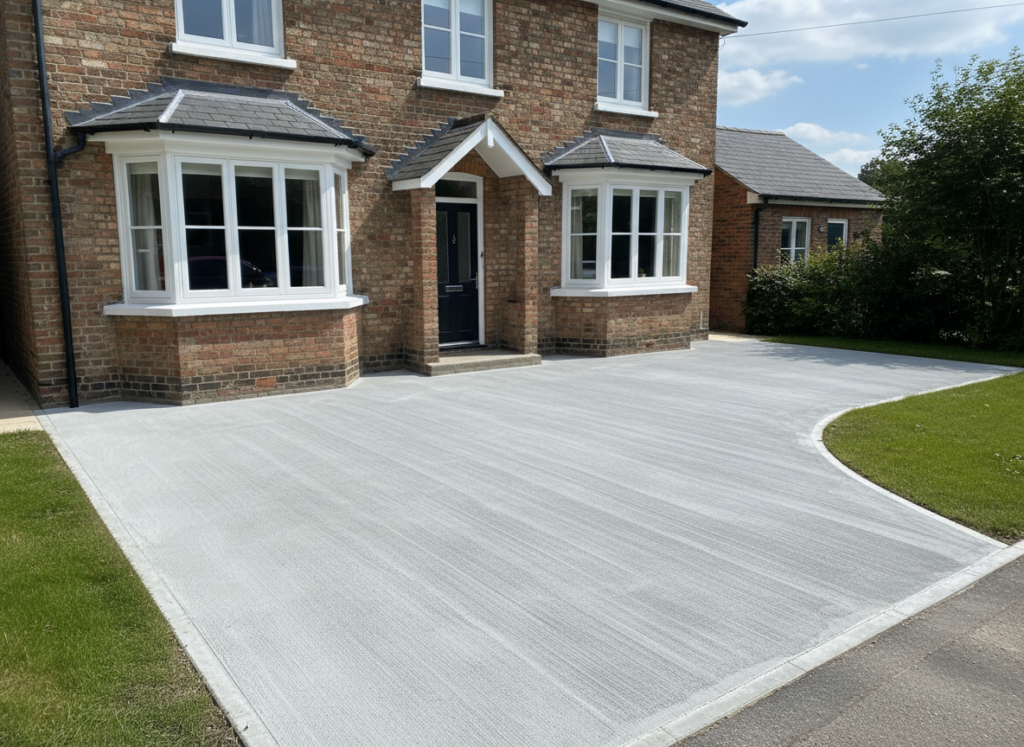
The finish is not a matter of taste alone. A driveway wants a brushed or tamped texture for grip. A power-floated surface, which is the right answer for a warehouse floor, is dangerously slippery outdoors in the wet.
Working out driveway volume
Area times depth, in metres. A drive 12 metres long and 3 metres wide at 100mm is 12 x 3 x 0.1, so 3.6 cubic metres.
Most drives are not rectangles. Split an awkward shape into rectangles and triangles, work each one out, then add them. Allow for the parts nobody measures: the apron at the road, the flare where the drive widens at the gate, and the thickened edge where there is no kerb to restrain it.
Getting the concrete onto the drive
A driveway pour is unusual in that the finished surface is also the access route, so the lorry cannot drive on it. The concrete has to be discharged from where the lorry stands and worked outwards from the far end.
That makes frontage the deciding factor: whether a mixer can stand on the road outside, whether it can be there long enough to discharge, whether parked cars leave room, and how far the far corner of the drive is from the kerb. Where the distance beats the chute, the options are barrowing, a smaller mini-mix vehicle making more trips, or a concrete pump. Kent Readymix takes that detail with the enquiry rather than discovering it on the day.
Ordering concrete for a driveway
Send the length and width, the depth, what will park on it, and where a lorry could stand. Your quotation, delivery and payment are agreed directly with the approved supplier appointed to your pour.
One practical note on timing. Do not book a driveway pour into a hard frost. Concrete gains its early strength in the first day, and a surface that freezes before it has that strength scales and dusts permanently. Our approved suppliers will tell you when they would rather move a date, and it is worth listening to.
Work Out How Much You need
Concrete Volume Calculator
The concrete calculator needs JavaScript. Contact us and we will work out the volume with you.
What We Do
Common Concrete Driveways Jobs We Handle
New driveway pours
Driveway replacements
Resurfacing over an existing base
Dropped-kerb access aprons
Turning and parking areas
Farm and yard access drives
Why book with us
Why Choose Us for Concrete Driveways
One Batch, One Consistent Strength
Ready-mix concrete arrives already mixed to a single specification, so the whole pour goes in at one strength from one batch. Concrete mixed on site in a barrow mixer varies across the area and leaves a cold joint wherever one batch met the next.
You Describe the Pour Once
Set out what you are pouring, roughly how much, where a vehicle can stand and when you want it. That description goes to the approved supplier appointed to the job, rather than being repeated down a list of numbers.
The Mix Specified Before It Is Ordered
Concrete is ordered by designation under BS 8500, not by description. A shed base, a driveway and a structural slab take different mixes, and the designation is settled with your approved supplier in advance rather than argued about on the day.
Access Settled Before Delivery Day
How the concrete reaches the work is the question worth answering first: what can legally stand in the street, how far the chute reaches, and whether a pump or a smaller vehicle is the honest answer. Describe the access and it is planned rather than discovered.
Volume Planned Rather Than Guessed
Where a volume is genuinely uncertain until the ground is open, a volumetric mixer makes the concrete on site and most of our approved suppliers work on a pay-for-what-you-use basis. Where the figure is known, a standard load is usually the simpler answer.
Every Pour Type Across Kent and Medway
Slabs and floors, footings and foundations, driveways, columns and walls, volumetric and mini-mix loads, and pumping where a vehicle cannot reach the work. Domestic and commercial, across Kent and the Medway towns.
We’re Here To Help
Your Common Concrete Driveways Questions Answered
It depends on the width of the approach, whether there is anywhere to pass, and whether the lorry has room to stand while it discharges. Kent Readymix takes the access detail with the enquiry, and where a full-size vehicle will not fit comfortably, mini-mix delivery or a concrete pump is used instead so the right vehicle arrives first time.
Not always, though it helps if someone is on site to confirm the access, show the delivery vehicle where to stand and answer any last questions. Once everything has been agreed in advance, a straightforward pour does not strictly need you there, but your approved supplier will tell you what they need for anything beyond a simple job.
Not directly. A new concrete driveway needs its own compacted sub-base beneath it, so an existing driveway usually has to be broken out and removed first rather than concreted straight over the top. Laying fresh concrete onto an old surface without proper preparation is a common cause of early cracking, and your approved supplier can advise on what the existing surface needs before quoting the pour.
A full road closure is rarely needed, but the section directly outside the drive usually needs to be kept clear so the delivery vehicle can stand and discharge safely. Parked cars, skips or other obstructions in that stretch are worth moving before the day. Your approved supplier will tell you exactly how much space they need once they know the frontage.
Any small surplus is normally used to thicken an edge, fill the apron at the road, or finish a corner that needed more than expected, rather than wasted. Genuine leftover material with nowhere useful to go returns with the vehicle. Ordering with a sensible margin, which your approved supplier will advise, keeps this to a minimum in the first place.
Not completely: a quote is based on the dimensions, depth and access described when it is given, so it can change if the drive turns out a different size or needs a different vehicle once the frontage is seen. Your quotation, delivery and payment are agreed directly with the approved supplier appointed to your pour, and they will flag any change before ordering the concrete.
Local coverage, county-wide reach
Areas We Cover Across Kent
- Ashford
- Broadstairs
- Canterbury
- Chatham
- Dartford
- Deal
- Dover
- Faversham
- Folkestone
- Folkestone and Hythe
- Gillingham
- Gravesend
- Gravesham
- Herne Bay
- Hythe
- Maidstone
- Margate
- Medway
- Northfleet
- Paddock Wood
- Ramsgate
- Rochester
- Sevenoaks
- Sheerness
- Sittingbourne
- Snodland
- Swale
- Swanley
- Swanscombe
- Thanet
- Tonbridge
- Tonbridge and Malling
- Tunbridge Wells
- West Malling
- Westerham
- Whitstable
- Ashford
- Broadstairs
- Canterbury
- Chatham
- Dartford
- Deal
- Dover
- Faversham
- Folkestone
- Folkestone and Hythe
- Gillingham
- Gravesend
- Gravesham
- Herne Bay
- Hythe
- Maidstone
- Margate
- Medway
- Northfleet
- Paddock Wood
- Ramsgate
- Rochester
- Sevenoaks
- Sheerness
- Sittingbourne
- Snodland
- Swale
- Swanley
- Swanscombe
- Thanet
- Tonbridge
- Tonbridge and Malling
- Tunbridge Wells
- West Malling
- Westerham
- Whitstable