

0+
Trusted Local Experts
Concrete Pumping in Kent
A concrete pump moves concrete from where a mixer can stand to where the concrete is actually needed, through a pipeline or a boom. Kent Readymix arranges concrete pumping across Kent and Medway for pours that a chute cannot reach, and the pump and the concrete are booked together.
- 0%
Fixed Price Model
1-2-1
Personal Service
Local, reliable, fully insured
Boom pump or line pump?
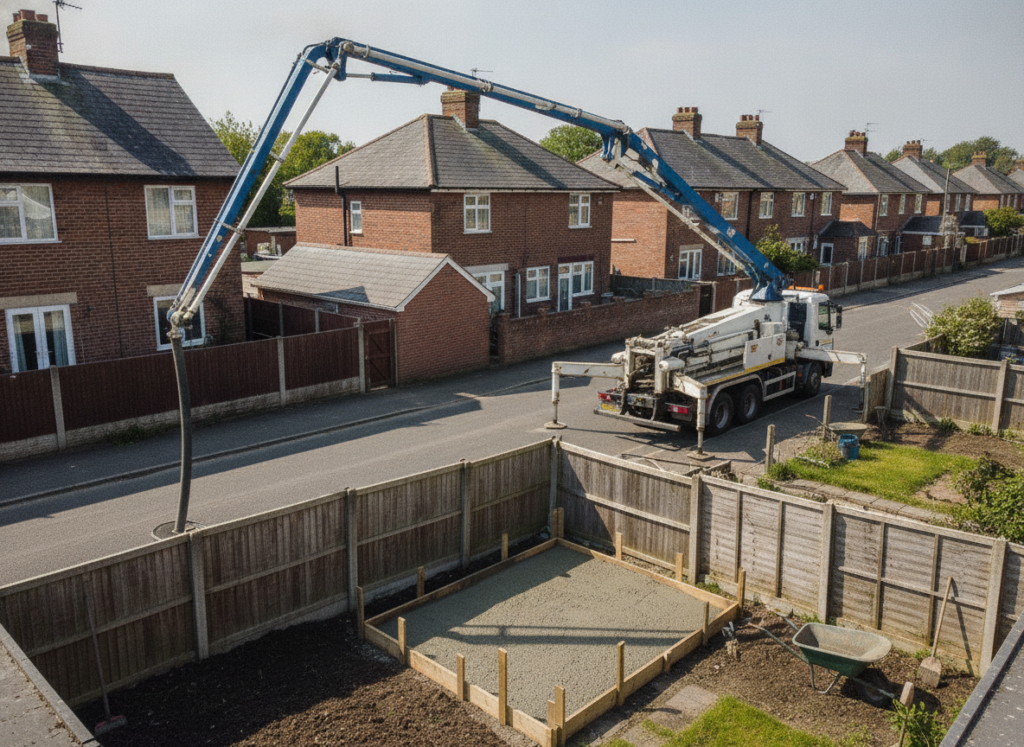
A boom pump is truck-mounted, sets up in the street or yard and places concrete over a building, across a garden or several storeys up under the operator’s control, and suits a pour that is high or beyond an obstacle. A line pump feeds concrete through hose laid on the ground instead, so it can go through a doorway, along a corridor and round corners a boom cannot see past, and suits a ground-level pour a long way from where a lorry can stand. The site decides which: a boom is usually faster where it will fit, and a line pump reaches where nothing else will.
When a pump earns its cost
The straightforward case is distance: the pour is further from the standing position than a chute reaches, and the alternative is barrowing.
The other cases are less obvious and often more compelling. A pour that has to be continuous, such as a raft, a large floor or a wall, because pumping keeps concrete arriving at the placing face without the stop-start of barrow runs. A pour at height, into columns or an upper floor. A pour where wheeling loaded barrows across finished surfaces, a lawn, a membrane or newly fixed reinforcement would damage them. And a pour where the placing rate has to match a formwork design.
Setting a pump up on a Kent or Medway site
A pump needs somewhere to stand, and the requirements are specific. Firm, level ground that will carry the machine on its outriggers. Enough room to deploy those outriggers fully, which is wider than the vehicle. Clear space for a mixer to reverse to the hopper. Overhead clearance, with overhead power lines treated as an absolute exclusion rather than something to work around.
What is underneath matters as much as what is above. Outrigger loads are concentrated, so a basement, a cellar, a culvert, a drainage run or a soakaway beneath the standing position is a serious question and not a detail. Establish it before the day.
Washout and water
Every pump job ends with the line and the hopper being cleaned out, and that washout has to go somewhere.
Concrete washout is strongly alkaline and is a pollutant. It must not enter a surface water drain, a watercourse or a highway gully, and doing so is an offence the Environment Agency can act on. Provide a contained washout point on site, agreed with the pump operator before work starts.
Provide a clean water supply as well. A pump needs water to prime the line at the start and to clean it at the end, and a site with no water is a site the operator cannot leave properly.
Concrete for a pump is ordered differently
Not every mix pumps. A pumpable concrete needs enough fine material to keep the coarse aggregate suspended and moving through the line, and enough workability to be pushed without segregating. A harsh, stony or stiff mix will block a line, and clearing a blockage is slow, unpleasant and occasionally dangerous.
Say at the point of order that the concrete is being pumped, and say how far and how high. The mix is adjusted for it, usually through consistence and sometimes through aggregate size. This is the single most common avoidable failure on a pumped pour, and it is avoided by one sentence on the order.
Booking the pump and the concrete together
The pump and the concrete have to arrive in step. A pump waiting on concrete is expensive standing time. Concrete waiting on a pump is a load approaching the end of its working life.
Kent Readymix arranges both through one approved supplier so the delivery pattern is planned around the pump’s placing rate rather than left to chance. Your quotation, delivery and payment are agreed directly with the approved supplier appointed to your pour.
Arranging a pump and a delivery together
Send the total volume, the distance from where a pump could stand to the pour, the height if the pour is above ground level, what is overhead, what is underground, and where washout could be contained. Between them those answers decide boom or line, and the size of machine.
For commercial customers on an agreed contract, delivery within hours is sometimes possible depending on location and availability. In every case your approved supplier confirms the window once the pump and the pour are scheduled together.
Work Out How Much You need
Concrete Volume Calculator
What We Do
Common Concrete Pumping Jobs We Handle
Pours beyond a mixer's chute reach
Upper-floor and first-floor slab pours
Extensions poured through a house or narrow access
Large continuous floor or raft pours
Pours over finished or landscaped ground that cannot be crossed by barrow
Agricultural building floors reached only by pump line
Why book with us
Why Choose Us for Concrete Pumping
One Batch, One Consistent Strength
Ready-mix concrete arrives already mixed to a single specification, so the whole pour goes in at one strength from one batch. Concrete mixed on site in a barrow mixer varies across the area and leaves a cold joint wherever one batch met the next.
You Describe the Pour Once
Set out what you are pouring, roughly how much, where a vehicle can stand and when you want it. That description goes to the approved supplier appointed to the job, rather than being repeated down a list of numbers.
The Mix Specified Before It Is Ordered
Concrete is ordered by designation under BS 8500, not by description. A shed base, a driveway and a structural slab take different mixes, and the designation is settled with your approved supplier in advance rather than argued about on the day.
Access Settled Before Delivery Day
How the concrete reaches the work is the question worth answering first: what can legally stand in the street, how far the chute reaches, and whether a pump or a smaller vehicle is the honest answer. Describe the access and it is planned rather than discovered.
Volume Planned Rather Than Guessed
Where a volume is genuinely uncertain until the ground is open, a volumetric mixer makes the concrete on site and most of our approved suppliers work on a pay-for-what-you-use basis. Where the figure is known, a standard load is usually the simpler answer.
Every Pour Type Across Kent and Medway
Slabs and floors, footings and foundations, driveways, columns and walls, volumetric and mini-mix loads, and pumping where a vehicle cannot reach the work. Domestic and commercial, across Kent and the Medway towns.
We’re Here To Help
Your Common Concrete Pumping Questions Answered
No, plenty of pours manage with a standard chute or mini-mix delivery, and a pump earns its place specifically where the distance, height or an obstacle between the vehicle and the pour rules those out. A continuous pour such as a raft or a large floor is another common reason to choose one. Tell us the site and we will say whether a pump is genuinely needed.
There is no fixed minimum, but pumping carries a setup cost that makes it better value on a pour of reasonable size, or on a small one where nothing else can reach. For a small job with good access, a standard delivery or mini-mix is usually the simpler option. Your approved supplier will say honestly which fits the pour you describe.
The pump can generally still operate in rain, but the concrete’s finish and the standing ground beneath the pump’s outriggers are the things most affected by wet conditions. Your approved supplier will advise on the day whether to proceed, and firm, well-drained standing ground for the pump matters as much on a wet day as the forecast itself.
No: Kent Readymix arranges the pump and the concrete together through one approved supplier, because the two have to arrive in step and a pump waiting on the wrong concrete is expensive standing time. Booking them separately with two different companies risks exactly that mismatch. We plan the delivery pattern around the pump’s placing rate so nothing waits on anything else.
A line pump reaches further into a site than a boom, running hose through doorways and around corners a boom cannot see past, so most access problems have a pumping answer even where a boom will not fit. Tell us what is overhead, what is underground and how far the pour is from any standing position, and your approved supplier will confirm boom, line, or an alternative.
Not because it is pumped, but the mix is adjusted for pumping through consistence and sometimes aggregate size, which is a specification difference rather than a price premium in itself. Saying at the point of order that the concrete is being pumped, and how far and how high, avoids a mix that blocks the line. Your approved supplier will quote against the pour once they know it is pumped.
Local coverage, county-wide reach
Areas We Cover Across Kent
- Ashford
- Broadstairs
- Canterbury
- Chatham
- Dartford
- Deal
- Dover
- Faversham
- Folkestone
- Folkestone and Hythe
- Gillingham
- Gravesend
- Gravesham
- Herne Bay
- Hythe
- Maidstone
- Margate
- Medway
- Northfleet
- Paddock Wood
- Ramsgate
- Rochester
- Sevenoaks
- Sheerness
- Sittingbourne
- Snodland
- Swale
- Swanley
- Swanscombe
- Thanet
- Tonbridge
- Tonbridge and Malling
- Tunbridge Wells
- West Malling
- Westerham
- Whitstable
- Ashford
- Broadstairs
- Canterbury
- Chatham
- Dartford
- Deal
- Dover
- Faversham
- Folkestone
- Folkestone and Hythe
- Gillingham
- Gravesend
- Gravesham
- Herne Bay
- Hythe
- Maidstone
- Margate
- Medway
- Northfleet
- Paddock Wood
- Ramsgate
- Rochester
- Sevenoaks
- Sheerness
- Sittingbourne
- Snodland
- Swale
- Swanley
- Swanscombe
- Thanet
- Tonbridge
- Tonbridge and Malling
- Tunbridge Wells
- West Malling
- Westerham
- Whitstable