

0+
Trusted Local Experts
Concrete Walls in Kent
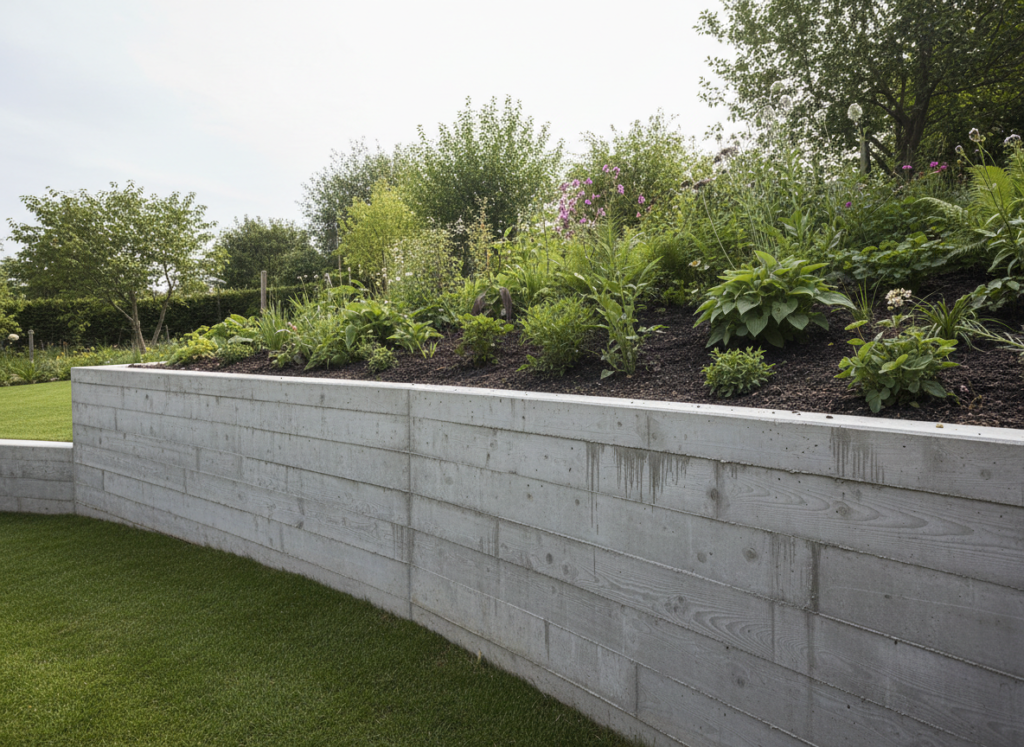
Poured concrete walls include retaining walls, basement and below-ground walls, foundation walls, and agricultural push walls and silage clamps. Kent Readymix supplies ready-mix concrete for walls across Kent and Medway, matched to what the wall is holding back and what it is exposed to.
- 0%
Fixed Price Model
1-2-1
Personal Service
Local, reliable, fully insured
The walls a ready-mix delivery is poured into
Four types cover most enquiries, each with very different requirements. A retaining wall is decided by how much ground and water sits behind it; a basement or below-ground wall does the same job while also keeping water out of an occupied space; a foundation or ground-beam wall carries structure; and an agricultural push wall or silage clamp wall takes impact from machinery and chemical attack from what is stored against it. Naming which of the four you are pouring is the first thing that changes the order.
Retaining walls are engineered, not estimated
A retaining wall fails by overturning, by sliding, or by the ground behind it failing, and all three are matters of design rather than construction. Height, surcharge from anything standing behind the wall, drainage behind the wall, and the reinforcement in it are set by a structural engineer.
That design gives you the concrete designation, which will be a reinforced concrete class rather than a general-purpose mix. We supply what it names. Where a wall is retaining any meaningful height of ground and no design exists, the missing item is the engineer, not the concrete.
Below-ground walls and water
Waterproofing of below-ground structures in the UK is covered by BS 8102, which sets out the forms of protection available. One of them, described as Type B, is structural integral protection: the concrete itself is the barrier rather than a membrane applied to it.
Where that is the approach, the concrete is specified accordingly and the workmanship carries the performance. Joints between pours become the critical detail, since water finds a construction joint long before it finds sound concrete. If your design calls for water-resisting concrete, say so at enquiry stage, because it is a specification and not a finishing option.
Agricultural walls and what they are exposed to
Push walls and clamp walls take repeated impact from loader buckets, so they are heavily reinforced and generously proportioned.
Silage introduces a second problem. Silage effluent is acidic and attacks ordinary concrete, so clamp walls need a mix that accounts for that exposure. Construction and containment of silage stores in England are also governed by the Silage, Slurry and Agricultural Fuel Oil Regulations, which set requirements for how effluent is contained. Check the current requirements with the Environment Agency before building, because they govern the design your concrete goes into.
Formwork, lifts and cold joints
Wall formwork sees the same pressure question as a column, and the same reference, CIRIA Report 108, governs it. The rate of pour is part of the design.
Pour a wall in continuous horizontal layers, each one placed and compacted into the one below before that layer stiffens. Where a pour stops for long enough for the previous layer to set, the result is a cold joint, which is a line of weakness and a path for water. Planned construction joints are made deliberately, in the right places, with the right preparation. Unplanned ones happen when the concrete supply cannot keep up with the placing.
That is why the delivery pattern matters on a wall pour and why it is worth agreeing with the supplier rather than assuming.
Working out wall volume
Length times height times thickness, in metres. A wall 10 metres long, 2 metres high and 250mm thick is 10 x 2 x 0.25, so 5 cubic metres.
Add the base. Most retaining walls sit on a footing or toe that is wider than the wall itself, and it is frequently a larger volume than the stem above it. Deduct nothing for reinforcement, and allow for whatever remains in a pump line at the end.
Getting a wall pour scheduled
Send the wall type, its dimensions, the designation from the design, whether it is below ground, and the placing method. Your quotation, delivery and payment are agreed directly with the approved supplier appointed to your pour.
Wall pours are the ones where continuity of supply matters most, so tell us the placing rate you need as well as the total volume. An approved supplier would rather plan the sequence than send everything at once.
Work Out How Much You need
Concrete Volume Calculator
The concrete calculator needs JavaScript. Contact us and we will work out the volume with you.
What We Do
Common Concrete Walls Jobs We Handle
Retaining walls for sloping gardens
Basement and below-ground walls
Agricultural push walls and silage clamps
Foundation and ground-beam walls
Boundary and screen walls
Why book with us
Why Choose Us for Concrete Walls
One Batch, One Consistent Strength
Ready-mix concrete arrives already mixed to a single specification, so the whole pour goes in at one strength from one batch. Concrete mixed on site in a barrow mixer varies across the area and leaves a cold joint wherever one batch met the next.
You Describe the Pour Once
Set out what you are pouring, roughly how much, where a vehicle can stand and when you want it. That description goes to the approved supplier appointed to the job, rather than being repeated down a list of numbers.
The Mix Specified Before It Is Ordered
Concrete is ordered by designation under BS 8500, not by description. A shed base, a driveway and a structural slab take different mixes, and the designation is settled with your approved supplier in advance rather than argued about on the day.
Access Settled Before Delivery Day
How the concrete reaches the work is the question worth answering first: what can legally stand in the street, how far the chute reaches, and whether a pump or a smaller vehicle is the honest answer. Describe the access and it is planned rather than discovered.
Volume Planned Rather Than Guessed
Where a volume is genuinely uncertain until the ground is open, a volumetric mixer makes the concrete on site and most of our approved suppliers work on a pay-for-what-you-use basis. Where the figure is known, a standard load is usually the simpler answer.
Every Pour Type Across Kent and Medway
Slabs and floors, footings and foundations, driveways, columns and walls, volumetric and mini-mix loads, and pumping where a vehicle cannot reach the work. Domestic and commercial, across Kent and the Medway towns.
We’re Here To Help
Your Common Concrete Walls Questions Answered
Often, yes, particularly for a wall of any height, because pumping keeps concrete arriving continuously at the placing face without the stop-start of barrow runs that can leave a cold joint. Shorter, low walls with easy access sometimes manage without one. Tell us the wall’s height, length and how a vehicle would reach it, and your approved supplier will confirm what the pour needs.
Not for anything retaining a meaningful height of ground, because a retaining wall fails by overturning, sliding, or the ground behind it failing, and all three are design questions rather than construction ones. A very low, lightly loaded wall may be judged locally, but where real height or water pressure is involved, a structural engineer’s design should come first and the concrete ordered against it.
There is no fixed minimum, but a very short run of wall may be more economical as mini-mix than a full lorry load. Send the wall’s length, height and thickness and an approved supplier will confirm whether a standard delivery, mini-mix or a smaller part load fits the volume involved.
Concrete has a genuine working life from the moment it is batched to the moment it is placed, and that window narrows in warm weather and lengthens in cool weather, so it varies rather than being a fixed figure. For a wall poured in continuous layers, the delivery pattern is planned so the next load arrives before the previous layer stiffens. Your approved supplier plans that sequence around the placing rate you need.
A lorry needs enough width to approach, room to stand within reach of the formwork, and ground firm enough to carry its loaded weight, and a boundary wall pour often falls short on at least one of those. Where it does, a pump or a smaller vehicle is used instead. Kent Readymix takes the access detail with the enquiry so the right vehicle is booked first time.
Not completely: a quote reflects the wall type, dimensions and designation described at the time, so it can change if the design is revised or the site turns out to need a different placing method. Your quotation, delivery and payment are agreed directly with the approved supplier appointed to your pour, and any design change is worth passing to them as soon as it happens.
Local coverage, county-wide reach
Areas We Cover Across Kent
- Ashford
- Broadstairs
- Canterbury
- Chatham
- Dartford
- Deal
- Dover
- Faversham
- Folkestone
- Folkestone and Hythe
- Gillingham
- Gravesend
- Gravesham
- Herne Bay
- Hythe
- Maidstone
- Margate
- Medway
- Northfleet
- Paddock Wood
- Ramsgate
- Rochester
- Sevenoaks
- Sheerness
- Sittingbourne
- Snodland
- Swale
- Swanley
- Swanscombe
- Thanet
- Tonbridge
- Tonbridge and Malling
- Tunbridge Wells
- West Malling
- Westerham
- Whitstable
- Ashford
- Broadstairs
- Canterbury
- Chatham
- Dartford
- Deal
- Dover
- Faversham
- Folkestone
- Folkestone and Hythe
- Gillingham
- Gravesend
- Gravesham
- Herne Bay
- Hythe
- Maidstone
- Margate
- Medway
- Northfleet
- Paddock Wood
- Ramsgate
- Rochester
- Sevenoaks
- Sheerness
- Sittingbourne
- Snodland
- Swale
- Swanley
- Swanscombe
- Thanet
- Tonbridge
- Tonbridge and Malling
- Tunbridge Wells
- West Malling
- Westerham
- Whitstable