

0+
Trusted Local Experts
Volumetric / On-Site Mixed Concrete in Kent
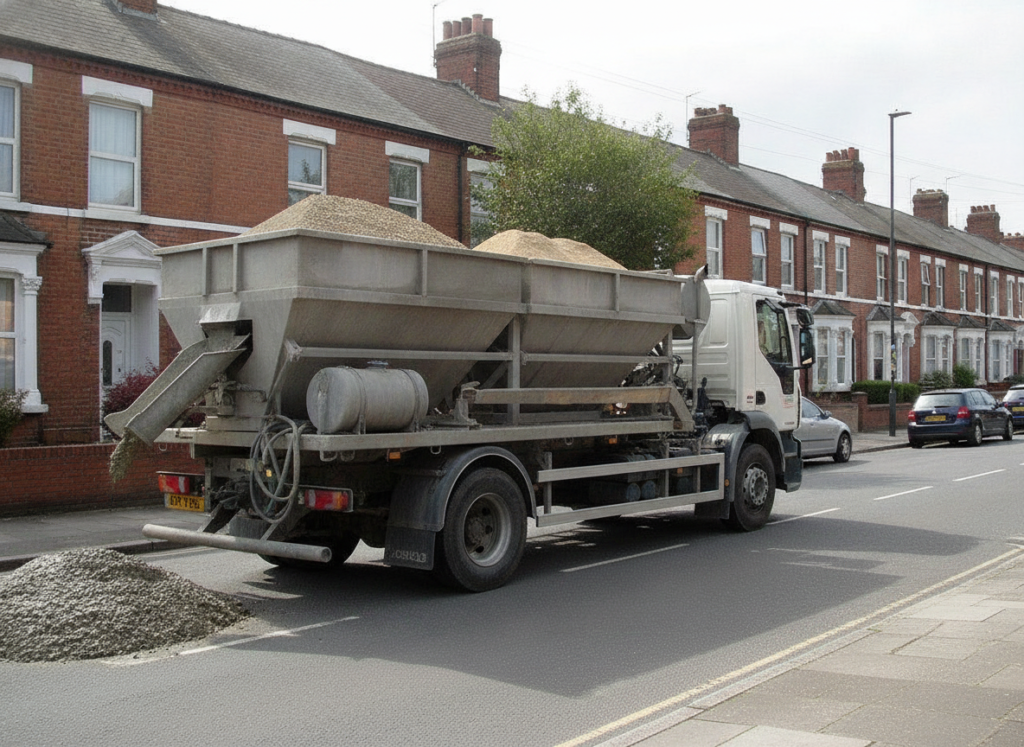
A volumetric mixer carries cement, aggregate, sand and water in separate compartments and combines them on site, so the concrete is made at the point of use rather than at a plant. Kent Readymix arranges volumetric concrete across Kent and Medway, and most of our approved suppliers work on a pay-for-what-you-use basis.
- 0%
Fixed Price Model
1-2-1
Personal Service
Local, reliable, fully insured
How a volumetric mixer works
The lorry is a mobile batching plant: raw materials travel in their own bins and are metered and combined through an auger at the back as they are discharged, so nothing is mixed until it is needed. That means there is no batch sitting in a drum from the moment it leaves a plant, and the concrete’s working life starts when it is made, on your site, in front of you.
Paying for what you use
Because the material is only mixed as it comes out, the quantity is settled at the end of the pour rather than at the start of it. You take what the job turns out to need.
That is what most of our approved suppliers mean by a pay-for-what-you-use basis, and it is the reason volumetric suits jobs where the volume is genuinely unknown until the pour is under way. An irregular excavation, a trench that has been dug wider in places, a void of unknown size, a levelling pour over uneven ground: none of these can be measured accurately in advance, and all of them are awkward to order as a fixed load.
Changing the mix without leaving site
A volumetric lorry can change what it is producing between one part of a pour and the next, because the ingredients are still separate. That covers the jobs where one visit has to do two things: a stiffer mix for a haunching and a flowing one for the trench, or a lean fill under a slab and a stronger mix in the slab itself.
That flexibility is in the vehicle, not in the specification. Where a designation is specified, by an engineer, on a drawing, or by building control, that is what gets batched, and a mix change during a pour should be a change between two designations that were both settled before the lorry arrived.
Is volumetric concrete BS 8500 compliant?
It can be, and what decides it is the producer rather than the mixer. BS 8500 and BS EN 206 are the standards concrete is specified and supplied against in the UK, and neither is a specification for a type of vehicle. The two UK certification schemes that sit behind them, QSRMC and the BSI Kitemark scheme for ready-mixed concrete, each state that their scope covers mobile batching vehicles as well as static plants.
The gate is certification. The designated concretes under BS 8500, the GEN, RC, FND and PAV families, are supplied on the strength of third-party product conformity certification held by the producer. A volumetric operator that holds it can supply them. One that does not cannot, and neither can a static plant without it. A producer without certification is working to the standardised prescribed mixes, the ST range, which are made to fixed proportions rather than to a performance requirement.
So the useful question is not whether the concrete is volumetric. It is whether the supplier is certified, and for which mixes. Kent Readymix passes that question to the approved supplier when you tell us the pour needs a specific designation, and you should ask for the designation to be confirmed and recorded on the delivery ticket.
That ticket is your record of what went into the ground. It is the document a building control officer would want during construction and a surveyor might ask for years later, and it is worth keeping with the rest of the paperwork for the job.
What changed for volumetric mixers, and what did not
The rules that changed for volumetric mixers between 2017 and 2018 were transport rules. The exemptions these vehicles held from annual testing and from operator licensing were removed, and a timetable was set for their weight limits to fall into line with other heavy goods vehicles.
Those are vehicle and haulage regulations. They did not change how concrete is specified, how a mix is designated, or how a producer demonstrates conformity. The two are worth keeping apart, because the change is often repeated second-hand as though it had been a judgement on the concrete, and it was not.
When volumetric is the right choice, and when it is not
Volumetric earns its place where the quantity is uncertain, where the mix needs to change, where a pour is spread across a long working period, or where a small overrun would otherwise mean ordering a second load.
It is not automatically the right answer. A large, well-defined, continuous pour with a known volume is normally better served by a drum mixer, sometimes by several in sequence, because the delivery rate is higher and the pour finishes sooner. Where a floor or a raft has to go in as one continuous placement, rate of supply matters more than flexibility. Kent Readymix will say which of the two suits the pour you describe rather than defaulting to one.
What a volumetric lorry needs from your site
A volumetric mixer is a large vehicle carrying its materials as well as its plant, and it is neither small nor light. It needs a firm standing, room to position, and clearance to work the discharge chute.
The practical checks are the ones you would make for any heavy vehicle: the width of the approach, overhead cables and branches, the load-bearing capacity of a private drive, and whether there is a soakaway, an inspection chamber or a septic tank in the ground it would stand on. Give us that detail with the enquiry and an approved supplier can confirm whether their vehicle fits before anyone commits to a date.
Volumetric and the delivery window
Many of our approved suppliers can deliver next day, and for commercial customers on an agreed contract, delivery within hours is sometimes possible depending on location and availability.
Your approved supplier confirms the window, because it depends on where the nearest available vehicle is and what else it is booked to do that day. Your quotation, delivery and payment are agreed directly with the approved supplier appointed to your pour.
Arranging on-site mixed concrete
Tell us what you are pouring, your best estimate of the volume, how confident you are in that estimate, and where the lorry could stand. The uncertainty is useful information here rather than a problem: it is the reason volumetric exists.
Where the volume is firm and the pour is large, we will say so and quote a standard delivery instead.
Work Out How Much You need
Concrete Volume Calculator
What We Do
Common Volumetric / On-Site Mixed Concrete Jobs We Handle
Irregular or hand-dug excavations of uncertain volume
Small extension or garden pours where a fixed load risks running short
Pours needing two different mixes in one visit, such as a haunching and an infill
Farm and equestrian bases on variable ground
Top-ups and small remedial pours
Why book with us
Why Choose Us for Volumetric / On-Site Mixed Concrete
One Batch, One Consistent Strength
Ready-mix concrete arrives already mixed to a single specification, so the whole pour goes in at one strength from one batch. Concrete mixed on site in a barrow mixer varies across the area and leaves a cold joint wherever one batch met the next.
You Describe the Pour Once
Set out what you are pouring, roughly how much, where a vehicle can stand and when you want it. That description goes to the approved supplier appointed to the job, rather than being repeated down a list of numbers.
The Mix Specified Before It Is Ordered
Concrete is ordered by designation under BS 8500, not by description. A shed base, a driveway and a structural slab take different mixes, and the designation is settled with your approved supplier in advance rather than argued about on the day.
Access Settled Before Delivery Day
How the concrete reaches the work is the question worth answering first: what can legally stand in the street, how far the chute reaches, and whether a pump or a smaller vehicle is the honest answer. Describe the access and it is planned rather than discovered.
Volume Planned Rather Than Guessed
Where a volume is genuinely uncertain until the ground is open, a volumetric mixer makes the concrete on site and most of our approved suppliers work on a pay-for-what-you-use basis. Where the figure is known, a standard load is usually the simpler answer.
Every Pour Type Across Kent and Medway
Slabs and floors, footings and foundations, driveways, columns and walls, volumetric and mini-mix loads, and pumping where a vehicle cannot reach the work. Domestic and commercial, across Kent and the Medway towns.
We’re Here To Help
Your Common Volumetric / On-Site Mixed Concrete Questions Answered
Not necessarily, because volumetric is priced on what is actually mixed and used rather than on a fixed load size, which can work out cheaper on a job where the volume is uncertain. A large, well-defined pour is often more economical as a standard delivery instead. Your approved supplier will quote against the pour you describe rather than assuming one method is always cheaper.
There is no fixed notice period for a volumetric pour, because it depends on how quickly an approved supplier can schedule a vehicle for your site. Many of our approved suppliers can work to short notice, but a job with an uncertain volume benefits from being discussed in good time rather than booked at the last minute.
Yes, to some extent: a volumetric mixer runs an auger and mixing mechanism while it discharges, so there is more ongoing noise than a standard lorry simply tipping down a chute, though neither is silent. Materials travel in separate compartments until combined, which generally keeps the site tidier than mixing in a barrow mixer. Your approved supplier can talk through what to expect for your site.
No, that is the basis most of our approved suppliers work to: raw materials stay in their separate compartments until they are mixed, so nothing is charged until it is actually combined and discharged. This pay-for-what-you-use approach is one of the main reasons volumetric suits jobs where the final quantity is not known until the pour is under way.
It can, where the job genuinely needs it, because the concrete is mixed fresh each time the lorry visits rather than delivered as one committed batch. This suits a pour that is naturally done in stages. Tell us the shape of the job and an approved supplier will say whether one visit or several makes more sense for what you are pouring.
The lorry carries enough raw material to keep mixing beyond the original estimate, so a pour that runs longer than expected can usually continue rather than stopping short. Where a job is genuinely open-ended on quantity, volumetric is often the right choice for exactly that reason. Your approved supplier will confirm what a particular vehicle is carrying before the pour begins.
Local coverage, county-wide reach
Areas We Cover Across Kent
- Ashford
- Broadstairs
- Canterbury
- Chatham
- Dartford
- Deal
- Dover
- Faversham
- Folkestone
- Folkestone and Hythe
- Gillingham
- Gravesend
- Gravesham
- Herne Bay
- Hythe
- Maidstone
- Margate
- Medway
- Northfleet
- Paddock Wood
- Ramsgate
- Rochester
- Sevenoaks
- Sheerness
- Sittingbourne
- Snodland
- Swale
- Swanley
- Swanscombe
- Thanet
- Tonbridge
- Tonbridge and Malling
- Tunbridge Wells
- West Malling
- Westerham
- Whitstable
- Ashford
- Broadstairs
- Canterbury
- Chatham
- Dartford
- Deal
- Dover
- Faversham
- Folkestone
- Folkestone and Hythe
- Gillingham
- Gravesend
- Gravesham
- Herne Bay
- Hythe
- Maidstone
- Margate
- Medway
- Northfleet
- Paddock Wood
- Ramsgate
- Rochester
- Sevenoaks
- Sheerness
- Sittingbourne
- Snodland
- Swale
- Swanley
- Swanscombe
- Thanet
- Tonbridge
- Tonbridge and Malling
- Tunbridge Wells
- West Malling
- Westerham
- Whitstable